In the luminous expanse where the Traveler's light bleeds into the void, I, a Guardian woven from starlight and memory, find my hands cradling instruments of both salvation and paradox. Our arsenal, a symphony of steel and arcane energy, sings songs of defiance against the cosmic dark. Yet, in the quiet moments between battles, when the echoes of gunfire fade into the hum of the Tower, my mind drifts to the very nature of these tools. They are extensions of our will, yet some bear the curious, almost whimsical fingerprints of a design that dances on the edge of dream and mechanics. The community's recent discourse has illuminated these beautiful, functional impossibilities—weapons that defy the mundane logic of a world without paracausal gifts, reminding us that we are wielding dreams given ballistic form.
The Hand Cannon's Whispered Secret
The hand cannon is more than a firearm; it is a statement, a piece of personal heraldry. I feel its weight, solid and reassuring, a chunk of forged certainty. Weapons like the legendary Fatebringer or the poignant Ace of Spades are icons, their silhouettes etched into the history of our struggles. They echo the noble profile of ancient Terran revolvers, the Colt Python, a ghost of a simpler time. Yet, upon closer contemplation, a poetic dissonance emerges. The barrel, often slung low, aligns not with the top chamber of the cylinder but the bottom. The hammer, proud and ready, sits high, poised to strike a phantom round. In the realm of physics I once knew, this configuration is a silent sonnet to impossibility—the hammer would kiss empty air, not primer. It is a design that speaks not to function, but to form; a silhouette chosen for its dramatic stance, its imposing posture, a visual metaphor for impact over ignition.
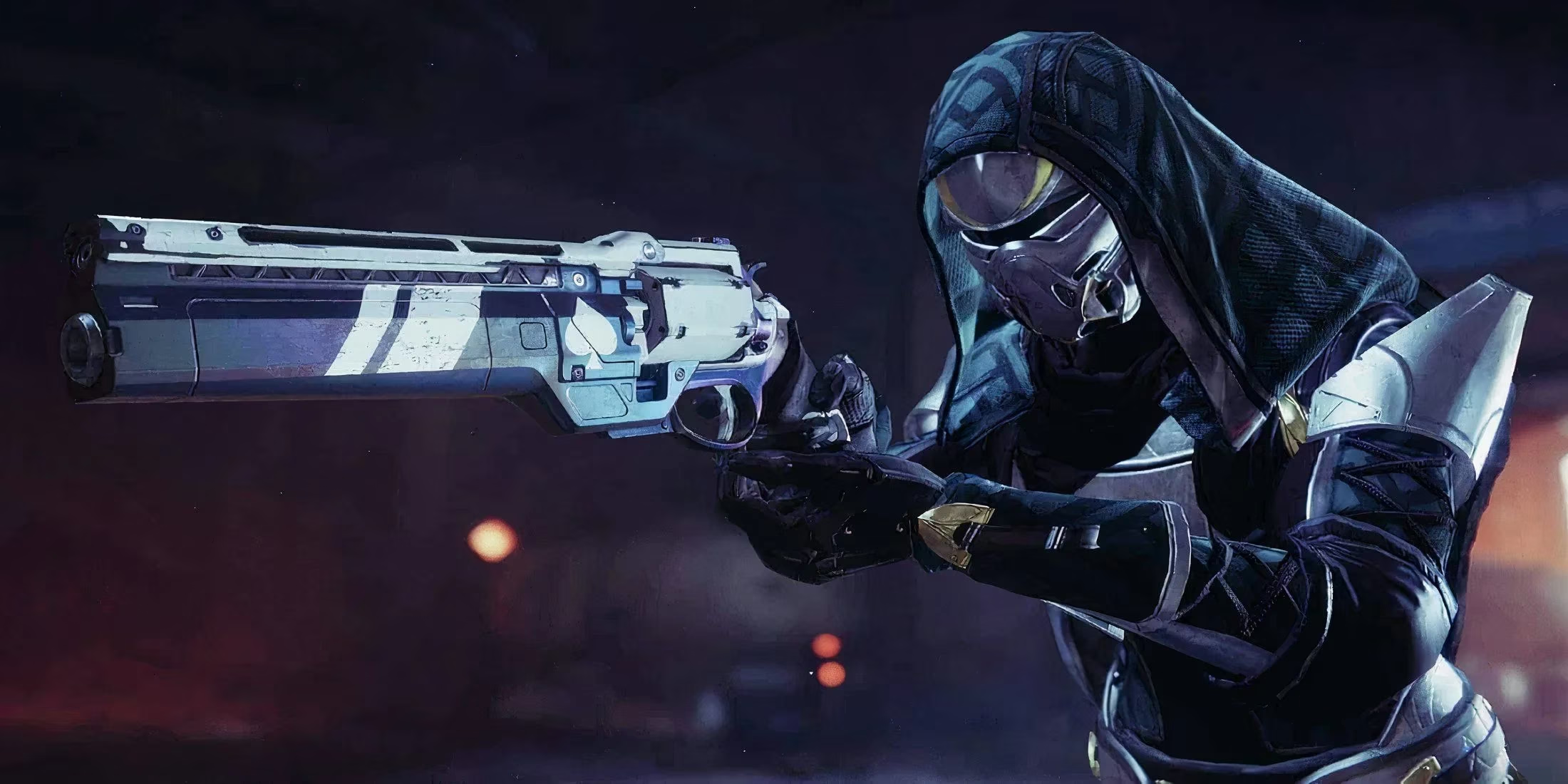
This revelation sparked not criticism, but a shared, fond amusement—a collective nod to the artistic license that permeates our reality. It underscores a fundamental truth: our tools are born of a universe where the rules are written in light and darkness, not solely in metallurgy and kinetics.
A Gallery of Mechanical Dreams
The hand cannon is but one verse in a longer poem of peculiar armaments. My fellow Guardians, with a chuckle in their comms, began to share other cherished anomalies. The conversation blossomed into a gallery of delightful impossibilities:
-
The Conspirator's Paradox: This scout rifle, a relic from the Leviathan's opulent halls, possesses a stock with a misaligned soul. Its magazine and barrel share no intimate pathway; a bullet housed within would find its journey eternally blocked, a traveler with no road. It stands as a monument to aesthetic choice, its form a beautiful, non-functional sculpture.
-
The Language of Unseen Mechanisms: Many of our weapons hum with energies that scoff at conventional propellants. They are conduits as much as cannons, their internal workings a mystery of Golden Age science or something stranger. Their resemblance to classic firearms is a nostalgic veneer over a core of transformative power.
-
Echoes from a Simpler World: The discourse also brought forth fascinating terrestrial mirrors, like the Chiappa Rhino—a real-world revolver that dares to place its barrel low. Its hammer is a decoy; a hidden striker performs the deed. It proves that even in the old world, innovation could bend the expected form, making our Guardians' arms feel less like mistakes and more like visionary, if exaggerated, kin.
This tapestry of design choices can be felt viscerally:
| Weapon Type | Poetic Anomaly | Implied Design Principle |
|---|---|---|
| Hand Cannon | Low barrel, high hammer alignment | Dramatic silhouette, symbolic power > mechanical fidelity |
| Scout Rifle (e.g., Conspirator) | Non-feeding magazine/barrel path | Form follows aesthetic theme, not ballistic function |
| Omolon Fluid Dynamics | Weapons that "fire" liquid light | Technology as alchemy, ammunition as essence |
| Häkke Ordnance | Brutalist, oversized components | Visual communication of raw, impactful force |
The Soul of the Forge: Why Form Transcends Function
Why do these "flaws" exist, not as oversights, but as inherent features? The answer lies in the very soul of our conflict.
We are not soldiers in a trench; we are mythic warriors in a symphony of cosmic forces. Our weapons must evoke as much as they eradicate. The hand cannon's imposing, low-slung barrel makes it look like it recoils upwards, visualizing its staggering power. The Conspirator's sleek, uninterrupted line pleases the eye, suggesting a sniper's elegance over an engineer's blueprint. In a world where I can summon a flaming hammer from the aether or unravel reality with a thought, the firearm becomes a focus, a ritual object. Its believability stems not from its mimicry of 21st-century tools, but from its flawless integration into a world of space wizards, sentient nebulae, and time-bending deities.
The design philosophy whispers: Authenticity to the universe supersedes authenticity to our past. Every curve, every seemingly misplaced component, serves the higher purpose of building a cohesive, immersive fantasy. When I raise my Fatebringer, I am not performing a mechanical action; I am conducting a moment of kinetic justice, and its form factors into that ceremony.
The Ever-Evolving Arsenal (2026 and Beyond)
As we stand in 2026, the forge fires of the Last City and beyond burn ever brighter. New arsenals from foundries like Cassoid or the re-embraced Suros regime continue this tradition. They introduce weapons with baffling, beautiful mechanisms—energy coils where magazines should be, barrels that seem to drink light before spewing it forth. The recent weapons gleaned from the depths of Neptune's secrets or the haunting landscapes of the Pale Heart feature organic, grown-looking structures that house what could barely be called a firing pin. The principle remains: each new design is a verse added to an epic poem of armament, prioritizing the evocative and the thematic. They feel at home in our hands because they feel born of our world's strange, splendid logic.
In the end, holding these impossible guns, I feel a connection deeper than utility. They are relics of a narrative, pieces of a dream where the rule of cool is a fundamental law of physics. Their so-called flaws are, in truth, their most authentic features—signatures from a universe that chose wonder over mundanity. They remind me that my power was always meant to be extraordinary, and my tools, therefore, could never be ordinary. They are not mistakes in design, but perfect expressions of a reality where a gun is never just a gun; it is a stanza in an endless, blazing epic of light against dark.
This discussion is informed by Rock Paper Shotgun, and it helps frame Destiny 2’s “impossible” weapon silhouettes as intentional worldbuilding—where visual language, faction identity, and feel-at-the-trigger matter as much as real-world firearm geometry. Read through that lens, quirks like off-kilter cylinders, non-feeding magazine paths, or energy “ammo” housings aren’t errors to be corrected so much as consistent signals that the sandbox is built for mythic readability and paracausal rule-of-cool rather than strict mechanical authenticity.