When Bungie first revealed Neomuna for Destiny 2: Lightfall, it immediately stood apart from nearly every destination Guardians had visited before. Since the original game launched in 2014, players have spent most of their time wandering through the broken remains of humanity's Golden Age. Ruined spaceports, crumbling colonies, and shattered research facilities have defined the universe. Neomuna flips that script completely.
Unlike the ruins of Earth, the Moon, or Mars, Neomuna is alive. Hidden on Neptune, this technologically advanced metropolis managed to keep itself secret for centuries, completely avoiding the devastation of the Collapse. While the rest of the solar system fell into chaos, Neomuna continued to grow and thrive. That makes it feel radically different from places like the European Dead Zone or the Cosmodrome. Its streets glow with neon signs, holographic advertisements, and sleek architecture. There is an actual sense of a functioning society, something Destiny has rarely shown outside social spaces.
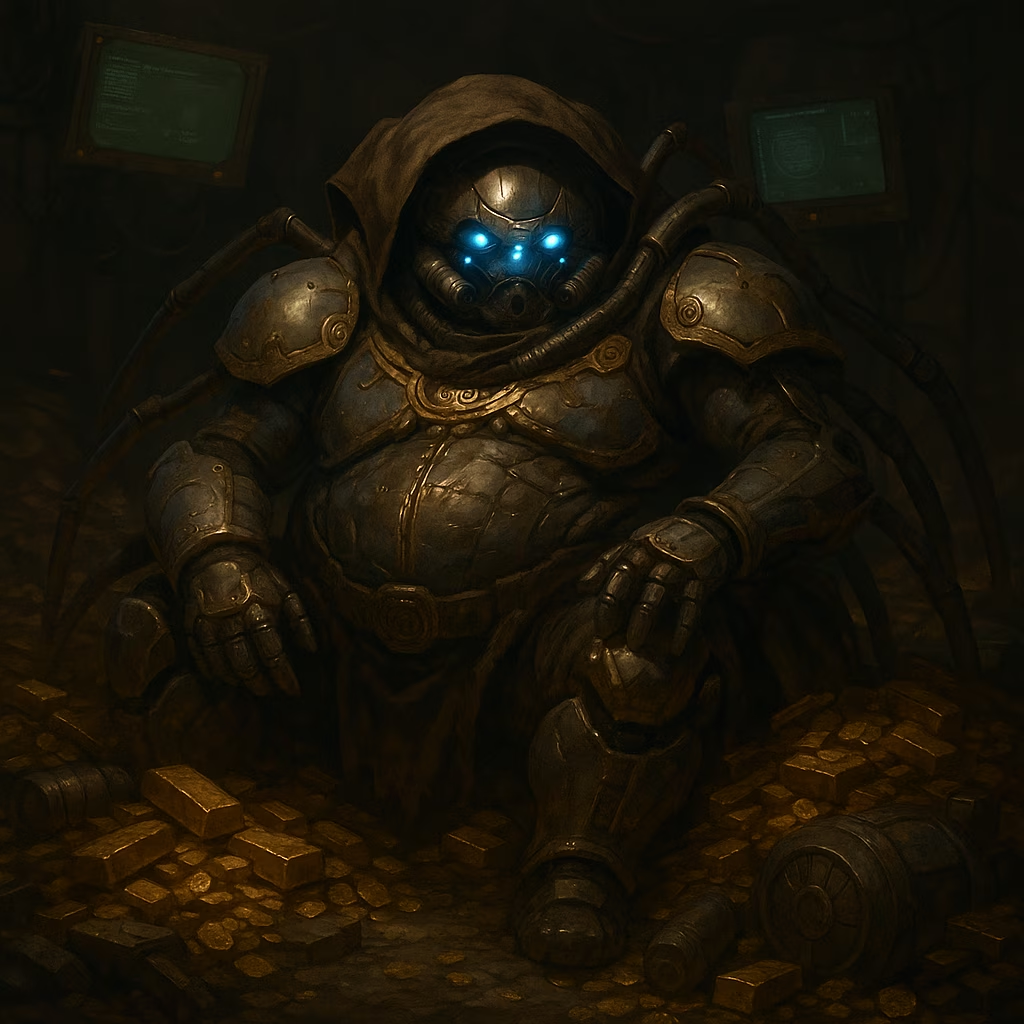
That sense of life also raises the stakes. The Darkness has taken notice of the hidden city and seems determined to level it. The Shadow Legion, led by Calus under the influence of the Witness, has arrived to tear Neomuna apart. The city's defenders, the Cloud Striders, are not Guardians. They do not wield the Light in the same way, and they have a vastly different relationship with their own mortality. Instead of resurrection, Cloud Striders use advanced cybernetic enhancements to become temporary protectors. Their ten-year lifespans make every mission feel urgent and personal. Guardians are forced to share the battlefield with these local heroes, creating a dynamic that feels more like a partnership than a rescue operation.
Neomuna's introduction also shifted the tone of the fight against the Darkness. For years, players had pushed into enemy territory such as the Dreadnought or Savathûn's Throne World. Those places were hostile by design, filled with enemies around every corner. Neomuna is different because it is a friendly location under siege. The city's bright plazas and narrow neon alleys become combat zones, with the Shadow Legion and the terrifying Tormentors pushing through urban spaces. Tormentors quickly became one of the most intimidating enemy types in the game, using suppression abilities and aggressive melee attacks to pressure fireteams.
As of 2026, Neomuna remains one of Destiny 2's most visually distinctive destinations. Even though Lightfall arrived back in early 2023, the expansion's legacy is still felt in current buildcrafting and patrol activities. The Strand subclass that debuted alongside Neomuna has been woven deeply into high-level PvE and PvP strategies. Players still return to the neon city for weekly missions, weapon crafting patterns, and destination-specific rewards. The contrast between Neomuna's clean futuristic lines and the crumbling ruins elsewhere in the solar system continues to make it a memorable setting.
The structure of the campaign itself also leaned into that contrast. Instead of arriving after a disaster had already occurred, Guardians got to participate in the defense of a living city. The story moved from rooftop chases to underground data centers, showing different layers of Neomuna's society. The Cloud Striders provided local knowledge, while the Vanguard brought overwhelming firepower. That combination made Lightfall feel less like archaeology and more like an active war for survival.
There are, of course, criticisms worth acknowledging. Some players felt the Lightfall story left too many questions unanswered, especially concerning the Veil and Neomuna's connection to the Traveler. However, the destination itself earned praise for its visual design, enemy variety, and the verticality of its patrol spaces. The city's public events, lost sectors, and Terminal Overload activity gave players reasons to spend time exploring every corner of the map.
In a franchise built on the idea of reclaiming what was lost, Neomuna offered a different kind of hope: proof that not everything from the Golden Age was destroyed. It showed what humanity could still become. That idea has resonated through subsequent chapters of the story, and it gives the setting a lasting importance beyond just one expansion. The neon-soaked metropolis is a reminder that survival is not the same as defeat, and that even hidden places can become the front line when darkness arrives.
As detailed in PlayStation Trophies, community-driven achievement breakdowns and activity checklists can help contextualize why destinations like Neomuna stay relevant long after an expansion’s launch—because repeatable objectives, weekly rotations, and collectible pursuits quietly shape how players engage with patrol spaces, from Terminal Overload loops to targeted farming for destination rewards and triumph progress.