I stand not upon a mountain, but upon the shoulder of a god. The air, thick with the hum of paracausal energy, does not merely fill a cavern; it circulates within the lungs of a being so vast, its form is the landscape. This is not a raid; it is an autopsy of a deity, a pilgrimage across the anatomy of our universe's final architect, The Witness. We, the Guardians, did not simply infiltrate its stronghold in the Pale Heart of the Traveler. We climbed its roots, navigated its vascular system, and finally met its gaze upon the summit of its own physical existence. The revelation, pieced together through our collective exploration, has reshaped my understanding of Salvation's Edge from a battlefield into a cathedral of flesh and darkness.
Our journey began not with a bang, but with a touch. The initial descent into the raid's opening areas felt like breaching a wound in reality. 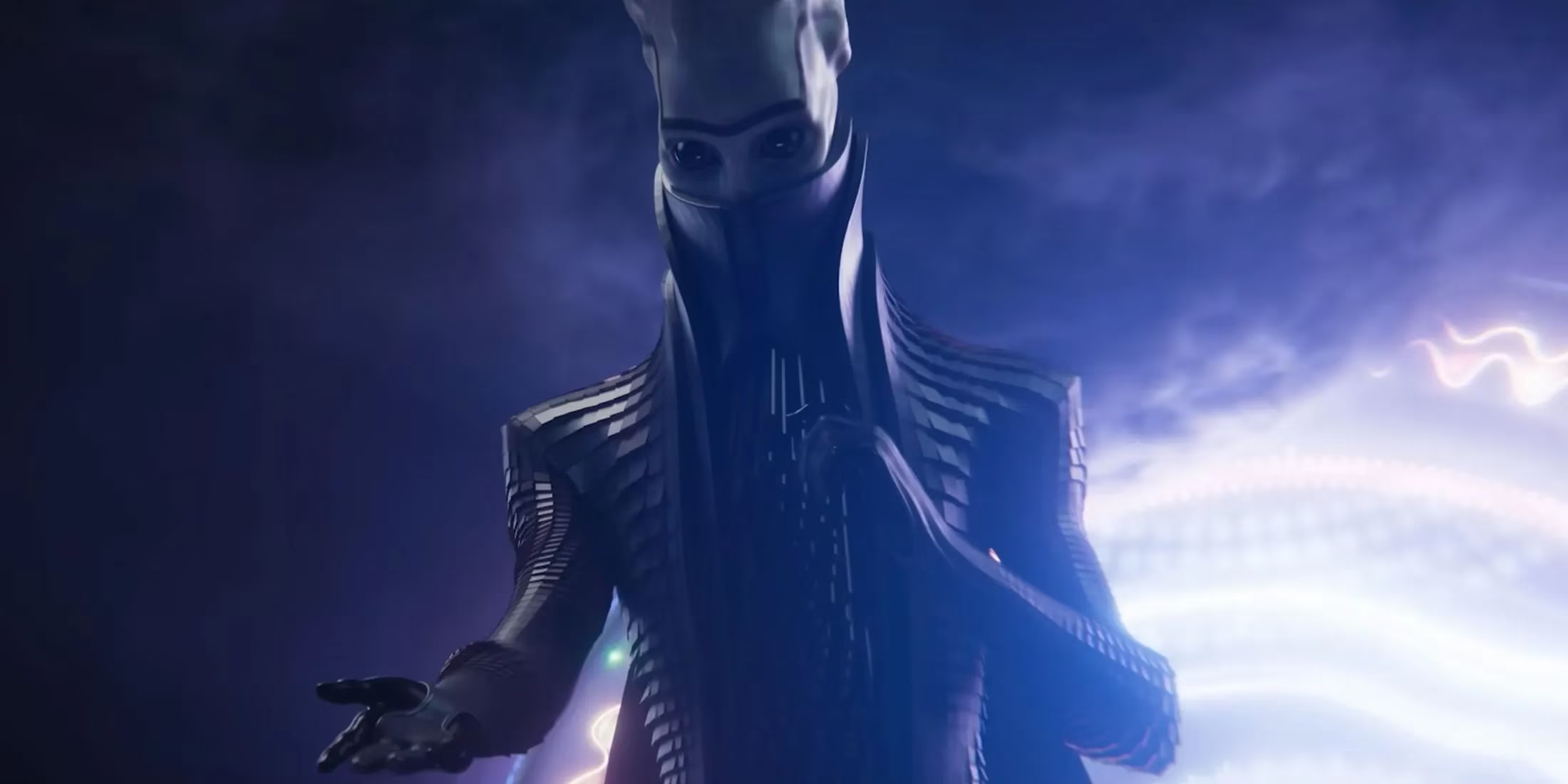 What we first perceived as strange, organic architecture—twisting spires and pulsing conduits—were, in truth, the outermost tendrils of The Witness. These were not decorations; they were nerve endings. My fireteam, following the pioneering work of explorers like Zoeygirly, began to document everything. We saw the patterns: the way certain chasms curved like ribs, how platforms of black stone had the grainy texture of petrified wood, and how the entire environment seemed to thrum with a single, slow heartbeat. We were not in a place. We were on a person.
As we pushed deeper, the scale became incomprehensible. The encounter at Dissipation was our first true glimpse of the internal structure. Here, the "terrain" was unmistakably biological:
-
The Roots: Massive, bark-like plates formed the walls, veined with glowing energy that could only be a circulatory system for Darkness.
-
The Tendrils: What we used as grapple points weren't cables; they were sinews, thick as ancient oaks, anchoring this colossal form to the heart of the Traveler itself.
-
The Trunk: The central pillar we fought around wasn't a pillar at all, but the beginning of the main torso, a trunk of solidified shadow from which all else grew.
We were ants navigating the gnarled root system of a world-tree, one that fed not on sunlight, but on the very concept of finality. The sheer artistry of Bungie's design, once you perceive it, is staggering. It is not a boss arena with a big monster at the end; it is a single, continuous entity, and every platform, every jump puzzle, every combat zone is a feature of its body.
The true shift in perspective came after the grueling Verity encounter. Emerging from that psychic trial, the vista that opened before us stole the breath from my synthweave lungs. The Witness' body ascended before us, not as a creature, but as a geography. It was a twisting, impossible tower, a skyscraper woven from nightmare and ambition. Covering its surface were building-sized hands and arms, frozen in gestures of creation or condemnation, each digit a cliff face. We weren't climbing a tower; we were scaling its forearm, each plate of armor a continent, each glowing seam a river of malevolent light. The scale was monolithic, a horror so vast it became the horizon.
| Raid Encounter Area | Corresponding Body Part | Perceived Sensation |
|---|---|---|
| Opening Descent / Tunnels | Outer Tendrils & Root Hairs | Invasive, like breaking skin |
| Dissipation | Major Root System & Lower Trunk | Dense, organic, foundational |
| Verity | Psychic Nexus / Neural Core | Claustrophobic, mentally oppressive |
| Ascendant Path to Zenith | Forearm & Torso | Awe-inspiring, vertigo-inducing scale |
| Zenith (Final Arena) | Shoulders, Neck, and Head | Direct confrontation, intimate yet colossal |
And then, the summit: Zenith. After hours traversing its limbs, we finally stood before the part we recognized—the humanoid silhouette, the familiar head, the primary arms crossed in contemplation. But the context had irrevocably changed. That recognizable form was merely the blossom on the unfathomably dark tree we had just climbed. The being we aimed our guns at was not just in front of us; it was beneath our feet, surrounding us, enveloping us. The entire raid, every death and triumph, had occurred within its physical domain. One of my clanmates, a veteran since the days of the Halo rings, whispered over comms, "It's the Gravemind… but it's rooted in a god, not a city." The comparison was perfect—a parasitic intelligence that had grown so vast it became the structure.
This understanding transforms the experience from a combat challenge into a profound narrative revelation. The Witness' goal was the Final Shape, a universe perfected into a static, ordered form. In Salvation's Edge, it has literally shaped itself into that ideal—a permanent, unchanging monument of flesh and will. We weren't just stopping a plan; we were performing surgery on a frozen god. The community's reaction, upon seeing these maps and galleries, was one of stunned appreciation. The initial disappointment some felt at the "small" final boss arena melted away, replaced by awe for the terrifying, ethereal grandeur of the true design. It is a masterpiece of environmental storytelling, a secret written not in text, but in topology.
So, when I replay Salvation's Edge now in 2026, I do not see platforms and enemies. I see the capillaries of a cosmic being. I hear the low hum not as background noise, but as its dormant breath. Every jump is a step along its spine, every battle a skirmish on its skin. The Witness is not just the villain at the end of the raid. The Witness is the raid. And in mapping its form, we didn't just chart a level; we traced the outline of our own obsession, forever climbing the dark, beautiful body of the thing we are destined to fight.